
PMI North Macedonia Chapter · board walkthrough · 29 September 2026
Built from nothing this month: one visual system, 199 pages, two languages, and two things no other chapter site in the region offers. Here is what it is, and what we would like to build next — with you.
Every colour on these pages was sampled from the chapter’s own PMI logo files — PMI’s current black, cyan, orange and purple — and grown into the scales the website itself is built from.
Not a template. A named set of colours, one typeface, five shadow steps and one photographic treatment — written down once, and used by every page. The chapter can shoot any photograph, write any page, and it lands on brand.
The palette — sampled from the chapter’s own logo
Purple — 50 to 950, tinted in OKLab
Cyan — 50 to 950
Orange — 50 to 950
Neutrals — every one of them tinted toward purple, so nothing on the site is ever grey
The tokens a page actually asks for — by job, never by colour
Orange always carries black text. White on orange is 3.0:1 and fails WCAG AA, so the system does not allow it.
The type — one family, Inter, self-hosted
One typeface for the whole site, carrying two axes: weight 100–900 and optical size 14–32. The optical-size axis is what gives a headline a display cut and body copy a text cut out of a single family — hierarchy comes from size, weight and tracking, never from a second face. It is served from the chapter’s own domain, so the site makes no third-party font request at all (part of why it needs no cookie banner). The Cyrillic subset carries every Macedonian letter.
Display cut — large optical size
Проектен
менаџмент
Text cut — small optical size
The same typeface, the same file. At body size Inter opens its apertures, widens the spacing and lowers the contrast so a paragraph stays readable on a laptop at arm’s length. Истиот фонт, различен оптички рез.
Behind Inter sit two stand-in faces built from Arial’s metrics — one tuned for body, one for display — measured in the browser, not estimated. They download nothing and they are the reason the page does not jump when the real font arrives.
Depth — five shadow steps, and every one of them is purple
A grey shadow on a purple-tinted ground reads as dirt. Every step carries a purple component, so depth on this site looks like light rather than like smudge.
The radius scale — 6 to 30, plus the pill
Badges take 6. Inputs and the logo plate take 10. Cards take 16. Feature cards, posters and images take 22. Full-width bands and the footer take 30. Nothing on the site picks a number that is not on this list.
Glass
The gradient the headline word wears
purple → violet → teal
Purple 600 to purple 500 to cyan 700. It is what a headline’s emphasis word is painted with, and it is what the chapter numbers and these chapter markers wear.
Photography — every picture the chapter owns, the same treatment
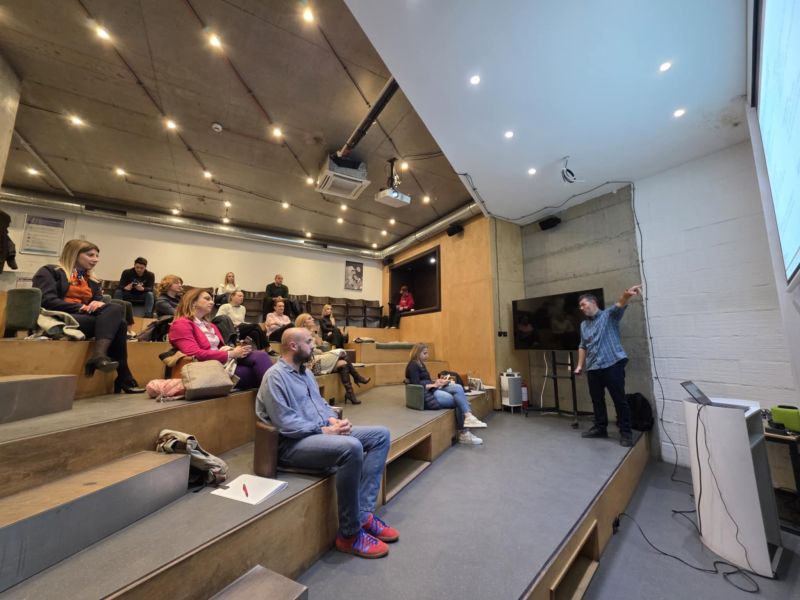
Greyscale, then a multiply with cyan-100 so highlights tint cyan, then a
screen with purple-400 so shadows lift instead of going black. The screen
step is the load-bearing one: it sets a floor, so no pixel of any photograph the
chapter ever shoots comes out darker than #8C7DD0. That is what makes
dark text safe on top of a photograph without anyone having to check each image.
Any picture, from any phone, at any event, lands on brand.
The motion — three behaviours, and this is them running
The real figures, from the chapter’s own record. They climb from zero and never flash their final value first — and with JavaScript switched off, a crawler or a screen reader still finds 1,236 in the HTML.
Everything in this deck fades and rises 22px on the way in, over one second, on the same easing curve the site uses. Nothing moves that a reader is not looking at, and a reader who has asked their computer for less motion gets the finished state immediately.
Where we came from
pmi-macedonia.mk runs WordPress with the Divi builder, hosted at MSP.
As of 28 September 2026 the home page is the only address on the whole site that
answers — every other link returns a server 404. That is a hosting-side fault,
not lost content, and it is not something this project caused or can fix from here.
We have not put a screenshot of it in this deck, because a fair before/after needs a real capture and the site will not serve one.
199 pages, statically built, served from Cloudflare’s edge. Macedonian and English side by side. No cookie banner, because it makes no third-party request. Every page answers on a fresh check: 0 console errors, 0 horizontal overflow, and 15,325 internal links with none broken.
It is live on staging now. Moving it onto the chapter’s domain is a
DNS change and it is deliberately the last step of the project — and the five
records that keep contact@pmi-macedonia.mk working all survive it.
A free CAPM practice bank, on the chapter’s own site, open to anyone — member or not, no login, no email address, no payment. That is the thing on this site that no other chapter in the region offers, and it is the reason a stranger has to come to us.
Live now
| Items | 60, written for this site |
|---|---|
| Exam | CAPM — Certified Associate in Project Management |
| Outline | The CAPM Examination Content Outline, “2023 Exam Update” (in force since July 2023): four domains, nineteen tasks |
| Format | 51 single-answer, 9 multiple-response |
| Difficulty | 25 easy · 31 medium · 4 hard |
| Where | /practice in English, /mk/vezbi in Macedonian — a quick ten, the full sixty, and a page per domain |
The bank follows the real exam blueprint
The outline weights the four domains 36% / 17% / 20% / 27%. A ten-question set drawn from this bank takes 4 / 2 / 2 / 2 — the weights, rounded to ten. A test in the build fails if the code and the blueprint ever drift apart.
What one question actually looks like
A municipality’s park-renovation plan treats the council’s confirmation of the budget before the planting season as certain, although the vote has not been held. The contractor must finish before the first frost, and last week a delivery of paving stones arrived damaged. How should the plan’s reliance on the budget vote be recorded?
Every option carries its own reason for being wrong — not just the right one. Then a rationale paragraph naming the principle that decides it and what a candidate who picked the runner-up misread, a pointer into the PMBOK Guide or the Agile Practice Guide (a pointer, never a quotation), and a short explanation in Macedonian. That is the shape of all sixty.
How it came about
“I want to include another set of web pages … which will essentially be able to train the visitor for their PMI certificate: we host the pool of questions and they can answer the questions and train for free for their PMI certificate … I do not want this to be fake, I really want our questions to represent the real difficulty and the type of questions they will encounter on their PMI certificate.”
Petar Trajchevski · 17 September 2026So before a single question was written, the three entry exams were compared — CAPM, PMI-ACP and PMP — on their real published outlines: how many questions, how long, what the stems look like, what a candidate needs before they may sit.
CAPM was chosen for three reasons. It has no experience gate, so it is the exam our newest members can actually take. Its stems are short and answerable honestly in a browser — the PMP changed on 9 July 2026 and now opens with a case-study section that cannot be imitated fairly on a web page. And the CAPM is the one certification where PMI’s own handbook names PMI chapters as an eligible provider of the required education hours. That is us.
What inspired the questions
PMI publishes five free CAPM sample items, dated 25 July 2023. Those five are the model: they were read closely for stem length, for how an option is made tempting without being a trick, for the register the exam is written in. None of PMI’s text is reused anywhere — the style is the inspiration, the questions are the chapter’s own.
Every item names the outline version it was written against. When PMI publishes a new outline, the version is bumped and every item disappears from the site until it has been re-mapped. That is the honest behaviour, and it is enforced in code rather than left to someone remembering.
Each item carries a review status, and a “found a problem with this question” link straight to the chapter mailbox. A board member with a PMP can sign off an item in the CMS.
In progress — not live yet
The board’s objection to the practice bank was fair: the page hands out all sixty questions and their answers, which is fine for practice and impossible to score. So the next thing being built is a weekly quiz that keeps its answers on the server.
The same ten questions for everybody, drawn 4 / 2 / 2 / 2 by domain — the exam blueprint. A random ten per player would make scores incomparable and a prize arbitrary.
The week runs Monday 00:00 to Sunday 23:59, Europe/Skopje. The draw is a function of the calendar, so the same week yields the same ten on any machine at any time.
Keys, reasons and rationales sit in database columns the question query does not select. Grading happens server-side; the answers come back only after you submit.
It is not live yet, and it is deliberately not on the site today. The quiz needs a database in the chapter’s own Cloudflare account before it can be deployed anywhere, and the leaderboard behind it is designed rather than built. A real prize would make fairness a requirement — and that is a board decision, not a technical one.
Not an opinion piece about the future of work. A working guide for the project manager who has a status report due at four o’clock: what to actually do, what never to paste into the box, and the prompt to copy.
guide pages — start here, context, the four ways to work, ten everyday jobs, what never goes in, trust but check, and PMI’s own AI material
prompts in the library, each tagged to the job it does, with a copy button and a list of what to give it and what to check
self-check questions, in the practice bank’s own format — two minutes, and you can send it to your team
weekly questions published so far, each with four options, a reason against every one, and the page that explains it
The rules the section is written under
✓Four assistants, always named, always in the same alphabetical order — ChatGPT, Claude, Gemini, Microsoft Copilot — so nothing reads as a ranking. No logos.
✓No model or version names anywhere. The pages teach concepts and features, which is what keeps them true after every product release.
✓No prices, for any product or any PMI programme.
✓A safety spine. Project managers hold contracts, salaries, client names and personal data. One page is entirely about what never goes into the box and the two settings that matter.
✓A named owner and a date. The hub says who last walked every source and when: Petar Trajchevski, 20 September 2026, re-checked quarterly.
✓Eight myth-versus-fact cards on the hub, each pointing at the page that explains it.
The ten jobs the section is organised around
The prompt library keys on these ten. Add a job, and the library has a shelf for it.
The honest state of it
The whole section is translated in one pass at the end. An English page filed under the Macedonian site would be a lie the site’s own checks cannot see, so it is not there.
All twelve prompts are written but none has been marked as tested in an actual assistant — and the page says so, on the page, rather than quietly implying otherwise.
Two collections in the site’s admin: the prompt library, and the weekly question. Adding a prompt or a question is filling in a form. No developer in the loop.
The site ships with its own editing console at /admin. News, events,
speakers, sponsors, board members, documents — thirteen collections, and each one
is a form. Writing a post is filling it in and pressing publish. No code, no email to
me, nothing waiting on my evening.
What the console already covers
Thirteen, defined in the site’s own public/admin/config.yml. Every field
is checked against the same schema the pages are built from, so a post that is missing
something is refused at the form rather than published broken.
How it works, in plain words
✓Both languages in one entry. Macedonian and English sit side by side in the same form, so a post cannot quietly exist in one language only.
✓Your words stay plain text. Everything saves as markdown files in the chapter’s own repository. Readable without any software, and no vendor can hold them.
✓Pictures upload from the form. Drop the photograph in; the site does the sizing, the formats and the duotone treatment on its own.
✓It is not part of the public site. The console is marked noindex — it is the board’s back room, not a page a visitor lands on.
What is honestly still missing, before any of you can sign in
→The site’s repository has to exist in the chapter’s own GitHub account. There is no remote yet, on purpose — the code and the content must land in the chapter’s name, not in mine. The console signs in against that repository, so until it exists there is nothing to sign in to.
→A small sign-in service has to be stood up so a board member can log in with a free GitHub account. It is an afternoon of work, not a project. Until then the console runs on a laptop straight against the files — which is how it has been demonstrated, and it is the same console.
Said plainly so that nobody is promised a login this week. The thing itself is built; the door to it is not hung yet.
Why after the conference
Every hour between now and the unveiling is going into the same thing: making the site look right and work properly on the day it is shown. Handing out accounts and running training in the same fortnight would leave both jobs half finished, and only one of them has a date on it.
So, after the conference: a free GitHub account for whoever on the board wants one, a walkthrough on a call, and a short editing guide in Macedonian — the kind you can follow at eleven at night without ringing anybody.
Then you write and you publish, on your own. I keep the technical side — the accounts, the deployments, the checks, the thing being up at two in the morning. The words are yours, and they should be.
A site is not a thing that gets delivered once and then sits there. What this one becomes over the next year is not a decision one person should be making on his own, and it is not a body of writing one person can produce.
Pages, wording, and the handful of things still shown in brackets because the board owes them: titles and photographs, the PDU split, sponsor prices, the documents. Every one of those is a sentence away from being finished.
News, events, speakers, the dilemma of the week. The console makes all of that yours to publish — what it needs after that is people who actually write in it, in their own voice rather than mine.
Seven guide pages and twelve prompts are a starting position, not a finished section. The jobs you really do on a Tuesday, the prompts that worked in your own tenant, and the things that went wrong.
The ask
This month a site got built. The proposal now is simple, and it is the whole thing rather than one corner of it: we keep building it together. You tell me what a page ought to say and I make the page say it. You write the news post, the event, the dilemma of the week — from the console, in your own words. You try an AI prompt in whatever assistant your employer allows and tell me what happened. I keep the code, the hosting, the checks, the sourcing rules and the quarterly re-read.
The AI section is one strand of that, and it is the strand with the clearest opening. Nearly everything written on the subject is in English and aimed at a large American company. There is no Macedonian-language, PM-specific guide to working with these tools. That gap is the opportunity, and this chapter is in a position to own it.
None of it is urgent this week — the conference is. But after it, everything above is on the table, and I would far rather we picked it up together than that I carried on building it alone.